Saturday, June 8, 2013

Review of 'Ender's Game' by Orson Scott Card


The genius of Ender's Game is its simplicity. The story naturally fits this style because the main character is a child. And the entire premise of the book is rooted in the observation that children show more skill at unraveling complex spatial relationships and at reacting instinctively and decisively to complex changing circumstances than mature adults. (Think of the Rubik's Cube puzzle - it took me, at age 35, fourteen hours to solve it the first time, whereas there are kids who have picked it up and solved it in minutes.) The simplicity of the theme goes beyond a child's perspective though: don't expect anything but the barest essentials of visual description or context. This is primarily a ride through a mind-scape: What it feels like to be Ender Wiggins and think like a child prodigy. More on that in a minute.

Ender's Game is dripping with intensity, but what I found most remarkable is that Card paints the tale with true believable emotion at the same time. This is pretty amazing considering it is basically what I call "Primitive Grunt Fiction" - that is, its all about self-preservation and using brute force to enforce it, the basest of animal instincts.

The story is about a kid who becomes a whiz at video games and uses that skill to remotely control a real military mission. Wonderful and believable (assuming you accept the zero-delay faster than light communication without which the entire premise breaks down). But a huge portion of the story takes place in an artificial enclosed zero-gravity "Battle Room" in which the characters use the walls and exits as key tools of their strategy. Wait a minute - space doesn't have walls. In the battle room the kids are the 'ships'. They propel themselves by inertia alone. Wait a minute - space ships have internal propulsion. Bottom line - sorry, but it's a real stretch to believe that confined "battle room" training would be the centerpiece of a training program for space warfare. Swallow hard and suspend disbelief.

Now back to the mind of a child prodigy. Card proclaims in his introduction that he never felt as though he thought like a child--and he uses this hopelessly skewed first-person observation to justify projecting fully adult thought processes into his child character. Yes, survival instinct is fully functional at that age. But psychologists will tell you (and research confirms) that a child's ability to project the long-term consequences of his/her actions is not. Some of Ender's behaviors exhibit mature, critical forethought to a level that even most adults don't achieve. For me, that destroyed the realism of the story. But once one decides to overlook this flawed premise, they can settle back for an enjoyable ride. It's one of the classics.

Friday, June 7, 2013

Reconciling evolution with religious beliefs

http://andgodsaidlettherebeevolution.weebly.com/uploads/6/3/5/5/6355787/9555144.jpg?312

Written by a pair of creative, imaginative and prolific scientist-writers, Charles Wynn, Professor of Chemistry, and Arthur Wiggins, Professor of Physics.  As a Ph.D. in Atmospheric Sciences myself (a branch of physics), and long time NASA researcher, I had great fun learning about the work of these distinguished gentlemen.

This dynamic duo has published four previous books over the last two decades, all of which seem geared to a teen/YA audience, and all of which educate and elucidate the novice into the exciting world of science.  To my way of thinking there is no more noble calling.  Two of these books have become standard classroom textbooks.

Now Charles and Arthur have teamed up as editors to tackle a sticky and sensitive issue.  Where is the middle ground, and is there common ground, between scriptural literalists and Darwinian science?  In 'And God Said, "Let there be Evolution"' they have enlisted three scientists/scholars of faith, one each from Judaism, Christianity, and Islam, to explain how they reconcile their deep-seated religious faith with the scientific evidence for the Theory of Evolution.

No work that tackles this field is going to be 'the last word.'  The opinions of three individuals, no matter how highly educated, is not going to sway those who adhere to a world-view that faith prevails over reason.

I am in the delightful position of having a well-educated Electrical Engineer daughter who went through a phase where she was a devout Christian biblical literalist.  Our discussions were always lively.  My bias--my 'world view'--was opposite of hers (though it is no longer.  When these conservatives' conception of hell began to make no sense to her, she moved on).  As a PhD scientist and one-time atheist-agnostic, my knee-jerk reaction to someone who would establish their belief system based on a 2000-year-old 'immutable, infallible' truth is "you've got to be kidding."  But hang on a minute.  If you truly adhere to your faith in 'critical thinking' and the open-ended nature of the scientific/rational process, wherein nothing is considered to be absolute immutable fact, (pending discoveries not yet made) then you cannot rule out the possibility that your 'faith' is just as unsupportable as theirs.

What I cling to is that we've uncovered a lot more evidence in the past 2000 years, so maybe those old texts ought to be updated.  What I admit is that there is a line of reasoning that asks: What if evolution is not random 'Natural selection' but a pre-programmed maturing of the universe toward an end that it (or some manifestation of a Maker) intended all along?  I explore these questions in great depth in my novel 'Eden's Womb'.

Okay, it's involving myself in these sorts of ever-evolving discussions that brings the sparkle to my heart.  Let the discussion continue :-)  Here is my selected 'best' review of 'And God Said, "Let there be Evolution".  It's from Dr. J. Harold Ellens: 

"Art Wiggins is a truth-teller of the first water. He has published, to genuine acclaim, such volumes as 1)The Joy of Physics, 2)The Five Great Ideas in Science, 3)The Five Biggest Unsolved Problems in Science, 4)Quantum Leaps in the Wrong Direction: Where Real Science Ends ... and Pseudoscience Begins; and now he inspires us with this new work on evolution, the biblical story, and a critique of the various creationism ideas. This volume proves to be a highly readable, popularly crafted, and comprehensive address to the fact that the overwhelming accumulation of verifiable scientific evidence demonstrates the universe and life on this planet has evolved over the long reach of time from early, simple forms of energy and material into increasingly sophisticated forms including life as we can know or discover it. The genius of this volume lies in the fact that Wiggins and his co-editor, Charles M. Wynn posed the question, "Is it possible to reconcile the Theory of Evolution with the Scriptures?" and then engaged three religious believers who are also scholarly scientists to provide thoughtful answers. Rabbie David Kay, Professor Howard Van Till of Calvin College, and T. O. Shavanas, a Muslim Physician responded with scientific evidence and argument, making it clear that accepting evolution does not require abandoning one's faith. In simple scientific prose that is laced with evidence of the authors' spirituality and with the relevant data from sacred scripture, these scientists demonstrate how their faith illumines their science and their science illumines their faith. The upshot of the whole work is a gratifying demonstration that evolution is the method God used to grow the universes and our world here on earth. I call this Theistic Evolution and am convinced that it is the only theory that handles all the scriptural and scientific data honestly and makes utter good sense. I believe that any other perspective betrays and falsifies the wonder of God's nature and work. Every high school and college student should read this work, and every believer should master it. This work ought to be a run away best seller because everyone should know of it and know it well. Sell your bed and buy this book." 

-

Wednesday, June 5, 2013

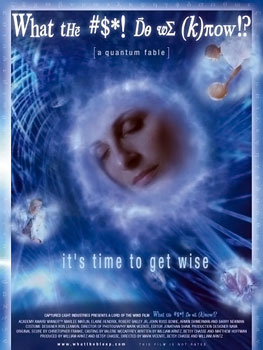
Review of 'What the Bleep do we Know?' DVD starring Marlee Matlin

File:Bleep lg.jpg

It is important to have a good, coherent negative review of this work to place in juxtaposition to the glowing positive reviews. Clearly this controversial 2004 movie is a 'love it or hate it' sort of affair with very little middle ground. (Just look at the hugely bimodal distribution, with lots of 1 star and lots of 5 star ratings on Amazon.)

Its subject: exploring the link between cutting edge physics (quantum mechanics in particular) and spirituality.  It begins with some very well-done tutorials about the physics but then leaps across a perilous abyss to claim some ground on the spiritual side.  This leap is taken without carefully identifying the middle ground between the two.

But there *is* middle ground. The amazing spooky world of quantum mechanics has so much richness of interpretation that scientists in the field are still arguing over it.  A recent Scientific American article (June 2013, pp. 47-51) highlights four different interpretations that could be called ‘world-views’ because they are so basic to the meaning of reality itself.  The concluding two sentences of this article are real eye-openers, quoting:  “As [Christopher A.] Fuchs [formerly of Bell Labs, Murray Hill, N.J.] puts it, ‘With every measurement set by an experimenter’s free will, the world is shaped just a little as it participates in a kind of moment of birth.’ In this way we become active contributors to the ongoing creation of the universe.”

This movie provides a service to the lay public in that it engages them in the world of science. If a few of these people become scientists rather than metaphysical practitioners, then we're all better off for it. If the language of quantum mechanics enters the public lexicon, it opens doors. Is a little knowledge a dangerous thing? Perhaps for some hapless individuals, but for society, no, because the consensus tends to be self-correcting. We continuously emerge from a little knowledge and achieve more. A thousand years in the future everything we know now will fill a thimble in comparison to the ocean of wisdom since achieved.

A simplistic application of the science, such as an assumption of universal quantum entanglement (everything started at the big bang, so everything is still connected in terms of its quantum field), or the more esoteric 'Measurement Problem' which says that somehow that entanglement becomes reality only when something is observed, can play a role in what we call 'consciousness'. The example I like to use is in the form of a set of questions: How many electrons does it take to fire a neuron in the brain? What causes an 'inspiration' in the conscious mind? Can a single electron circulating at just the right location in my mind, quantum entangled with one in yours, trigger a pattern in my cerebral cortex when you have a certain thought that triggers a similar pattern in your cerebral cortex?

This movie raises many such questions and then leaps into bold answers that have little rational justification or reproducible evidential support. But that doesn't deny the existence of the spooky quantum effects, nor should it undermine the value of posing these deep questions before a curious, inquisitive public.

Sunday, June 2, 2013

Review of 'A Walk in the Woods' by Bill Bryson

File:Bill Bryson A Walk In The Woods.jpg

I’ve read ‘A Walk in the Woods’ twice—once before my thru-hike of the Appalachian Trail and once after.  My impressions were much the same after both readings.  That’s because this is not the story of a thru-hiker’s experience.  It’s not even about a guy who failed his valiant attempt at thru-hiking but still wants to do the whole trail.  No, it’s more complicated than that.  Read on …

First of all, Bill Bryson's gift for humor is natural and delightful; and that's what makes ‘A Walk in the Woods’ the bestselling book on hiking the Appalachian Trail of all time, and the only one with the distinction of having been a New York Times Bestseller. As a member of the Appalachian Trail Conservancy (ATC), I found the research and factual elements of the book to be well done. But as an avid hiker who hiked the entire trail twice in one calendar year—2012—I was disappointed to learn how little of the trail Bryson actually covered.

The story follows Bryson’s 1996 thru-hike attempt from the planning stages, during which he recruited an old friend, Stephen Katz (a fictitious name) to hike with him.  Katz becomes a foil for a good deal of the humor through the book, some of it at the expense of ATC’s code of trail ethics, called ‘leave no trace’.   Bryson describes Katz as hurling various heavy belongings over cliffs and into the woods in order to lighten his load, and other reviewers have criticized him for approving, or tacitly advocating what amounts to a misdemeanor offense in most of the states through which the trail passes.

Bryson and Katz depart Springer Mountain, GA, the southern terminus of the trail, on March 9th.  It’s clear that the intent was to hike the whole trail.  But like so many before them (an estimated one in four succeed according to the ATC), this pair found the rain and mud and discomfort of the trail to be too much.  They got off the trail at Newfound Gap in the middle of the traverse through Great Smoky Mountain National Park, having hiked only 200 miles.

In describing his thoughts at this pivotal moment of ‘getting off the trail’, Bryson distills his feelings with this quote:  “A whole dimension of drudgery—the tedious, mad, really quite pointless business of stepping over every inch of rocky ground between Georgia and Maine—had been removed.  We could enjoy ourselves.”  I believe that every person who has ever long-distance hiked can identify with the sense of drudgery that can nag at us on bad days.  For me, and probably for most others who do not ‘get off the trail’ but keep pushing on, the ‘we could enjoy ourselves’ moments outweigh the moments of drudgery, or at least mitigate them enough to keep us going.

Bryson and Katz returned to the trail at Troutville, VA and hiked another continuous 240 miles to Front Royal, at the north end of Shenandoah National Park.  That was about it for any real long distance hiking.  On his own, Bryson hiked bits and pieces of trail, mostly as day hikes and short excursions, mostly near his home in VT and NH, plus a few bits of PA.  Finally he and Katz hiked 66 more miles from Caratunk, Maine to Katahdin Iron Works Road, and that’s where they gave up.  They never made it to Katahdin—the mountain at the northern terminus of the trail.  And as far as I know, Bryson has never climbed Katahdin, though he promises to do so in this book. 

Fine.  He ‘hiked his own hike’—a phrase that comes close to a universal ‘religious’ creed among the congregation of AT hikers.

But here’s my problem:  This book continues to ‘pretend’ to be a comprehensive ‘guide’ or ‘report’ about the AT.  The back cover blurb makes this blanket statement: “The Appalachian Trail stretches from Georgia to Maine and covers some of the most breathtaking terrain in America.  If you’re going to take a hike, it’s probably the place to go.  And Bill Bryson is surely the most entertaining guide you’ll find.”  Not one word, not even a hint or suggestion that he failed to hike the majority of this ‘most breathtaking terrain’ and so he doesn’t qualify as any sort of guide to most of the trail.  False advertising, blatant and unabashed.

Yet my greatest complaint about the book is about the writing itself.  The first half of the book was much more enjoyable than the second. My paperback edition is 400 pages, and the first 150 of them cover just that first 200 miles of hiking between Springer and Newfound Gap.  From there, not only did Bryson’s through-hiking dreams sputter, but so did the narrative drive of his prose.  The humor as well as the story lost momentum at that point and never regained it.

Another point significant to me: Born in Iowa, Bryson became an ex-pat when he moved to England in 1977.  His ‘discovery’ of the Appalachian Trail happened when, in 1995, he moved back to the US and settled in Hanover, NH, where the trail goes right through the middle of town.  Less than a year later he made his thru-hike attempt.  And then in 2003 he moved back to England.  I don’t quite know why, but that final move away leaves me cold.  So many of my friends who have hiked the Appalachian Trail, both thru-hikers and section hikers, have fallen in love with it, want to be close to it, want to come back and hike it again.  Bryson does not share this sentiment.  There’s no hint in the book that he has any deeper connection with the AT, and his move away from Hanover just seals that in my mind.  It’s sad to contemplate, but I’m left wondering whether this most popular of all AT hiking books was little more than an exploitation—a chance to make some money.

Nevertheless my bottom line is positive: ‘A Walk in the Woods’ is laugh-out-loud funny, so for me it’s a worthwhile read whether you are a hiker or just an appreciator of good light humor.
 -------------------------------------------
If you have an Amazon Account, please follow this link to vote on this review. Tell other customers if you found it helpful.
 

Friday, May 31, 2013

Two quick book reviews


Jurassic Park by Michael Crichton (published 1990)

Crichton's classic suspense thriller begins by appealing to the wow-factor of experiencing dinosaurs live on the page, but unlike the movie adaptation, which had to do some serious research to properly animate so many of the extinct creatures, the real story of the book is not about dinosaurs at all. It is about generic out-of control monsters, and people being chased by them.  As such it's still a really well done plot--the last two-thirds of the book hold the reader in constant suspense. As a weaver of a tale, Crichton is a master here. His writing style, on the other hand, ranges from comfortably smooth and readable to just plain bland, which, I predict will allow this book to gradually fade from center stage.


The Silmarillion by J.R.R. Tolkien

I loved Lord of the Rings--in fact it's one of my favorite books (OK, it's a trilogy, but you know what I mean). I’ve already published a review here, all in verse.  But I found Silmarillion to be a dreary, pedantic read. Far too much narrative, dragging on and on, rarely interrupted by dialogue. A few of the key parts of the story held my interest, but through too much of it I felt I was just plodding through.


Tolkien didn’t publish this stuff himself because it was unfinished, so he’s not to blame.  (It was published by his son in 1977.)  Blame his rampant popularity—fans want anything and everything he ever jotted down on paper.  I absolutely understand, but I guess those fans are a little more obsessive than I.

Sunday, May 26, 2013

Review of 'Dune' by Frank Hebert

When I review an old and hugely popular book (this one is from 1965) that already has a bazillion reviews done on it, I try to accomplish two things in my reviews:

1.  Start with a catchy first line to grab the reader.

2.  Say something nobody else has said before, while avoiding repeating what you'll read in other reviews.

So, with that as preamble, Here it is:


Dune is a brilliant story told by an incompetent fool.

Frank Herbert seems a deliberate pretender at his own trade. Because of his infatuation with pretense, he comes across to me as a stranger to the real substance of the world he spent so much time and energy building. He navigates it crudely, filling it with characters that are all variations on the same theme: brooding, self-possessed, cynical, valuing perception over reality.

My greatest complaint is that Herbert is constantly sabotaging his story’s narrative drive with pointless pseudo-introspective dialogue. He is fatally enamored with such dialogue. The worst of it—the most banal—he obviously recognizes, because he props it up with the cheapest of ploys: he has another character gush with praise over the insipid line.

Time after time he takes the brute force route through the tangle of possibilities that the intricate story line full of characters at cross purposes with one another presents to him—missing opportunity after opportunity for sophisticated story telling. Just one example: The Guild navigators couldn’t navigate their way out of a paper bag without their drug? All inter-space travel would collapse without said drug? Puh-leez!

Over and over he assembles a room full of way-too-many characters, swabs it with political tension and innuendo, and with laughably shallow pseudo-philosophy, and then has them stand/sit in static rapture of their own self-involvement and prattle on for 20 or more pages that neither advance the plot nor even produce any consequences to it. He is obviously enamored with politics—the art of appearing to be more than you are while saying less than you know. In the end, that’s what the entire book comes across to me as: an exercise in creating appearances without substance.

To his credit, Herbert is superbly talented at turning a phrase. The phrasing is rich, often poetic and always well crafted; and his characteristic writing style is a pleasure to read. Usually that scores big points with me. But not here. ‘Dune’ is touted as one of the most outstanding examples of its genre. I pointedly disagree.

rating: 7/10

Thursday, May 23, 2013

How to get your book published

Shepherding a book to publication is like coaxing an orchid into bloom.  This is a purple Dendrobium orchid, 27 year old plant, blooming today in my living room at the North Carolina beach.  Bought in Hawaii, this is one of the easiest orchids to care for.  It loves to be severely pot bound and wants to be watered only once a month.  Its long-lasting blosoms are among the most common used in leis.

It is a quantum event.  Suddenly, with the stroke of pen on contract, you become a published author.

For me, it seemed to happen overnight.  It was as if I went to bed a clueless wannabe and woke up an expert on getting published.  I pinch myself.  Am I still asleep?  Is this a dream?

Well, it wasn't a dream.  Nor was it an overnight success story.  The reality is far more complicated than some sort of mystical caterpillar-to-butterfly metamorphosis.  It was a long process, like a nurturing a plant until it flowers, or watching a sunrise crescendo to its apex out of the gloom of night.

Sunrise, North Topsail Beach, NC, May  21, 2013

It was a process that took patience, persistence, plenty of hard work, and commitment.  And, in fact, there's nothing magical about that moment when you can declare yourself a royalty-earning, no-fee paying, genuine published author.  Successful marketing of your product takes just as much determination and energy as the research, writing, revising, editing and pitching of your manuscript.

Hundreds if not thousands of blogs, essays and books have been written on the subject of getting published.  What I offer in this post is one person's experience.  As the epigraph to this blog says: I offer a few small crumbs to mark the path that led me to this significant way-marker in my writing journey.

In my experience there are two broad classes of authors.  First there are people who decide they want to be writers and then start looking for opportunities and homing in on preferred story lines or subject matter.  And then there are those who have something they want to write about.  These folk didn't necessarily intend to become writers, but if they are serious about getting their message out to the public, then they quickly realize that they're going to have to hone the writer's craft.  I fall in the latter category.

Which ever group you fit into, the first steps in becoming a published author are to practice and learn.  A formal education is the most reliable path to success.  Go to college and earn an English degree with a focus on writing; then follow that with an MFA - master of fine arts.  If your circumstances don't allow for formal education, then there's always the School of Hard Knocks.  Find a local writer's group or an online group.  Join a critique group and exchange drafts.  Learning to criticize the work of others will help you identify the weaknesses in your own craft.

Then write, write, write.  Revise, revise, revise, and write some more.  There's a wise saying among writers that goes: "The first million words are practice."  In my case, I continue to go through draft after draft of the book series 'Eden's Womb'.  Because I consider it my 'life work' - my magnum opus - I didn't want to give up on the plot or the ideas.  I have rewritten it entirely from scratch half a dozen times and revised more times than I care to remember.  I've had three different professional editors provide their (sometimes conflicting) developmental edits.  I learned different lessons from each.

For most other people the process of practicing and perfecting their skills involves a series of writing projects, each improving on the last.  You have to be pretty pig-headed to keep working on the same manuscript for decades.  'Stubborn' is not far from 'stupid' in the dictionary.  I wouldn't recommend my approach to others.

Look for feedback from people you respect.  Enter your writing in contests, send drafts out to unbiased reviewers, to editors, to agents - anyone willing to consider a paragraph of your writing and offer some response. Go online to writer-reader feedback sites like WattPad and Amazon Kindle Write On.  It is important to take the feedback you receive as constructive criticism.  Take it seriously even if you don't believe in it.  Use the criticism to experiment with different ways of presenting your ideas.  It's fine to believe in yourself and your skill; but I find that the most progress comes when I'm willing to explore ways to make what's already good better.  Remember that nothing created by a mere mortal is perfect.  There's always room for improvement.

The publishing industry is in a rapid state of flux.  Your choices for publication have never been greater.  Sometimes it seems that getting your work accepted by a 'traditional' big-house publisher or by many of the new no-fee small presses is harder than ever.  But it would be wrong to blame the system for your failures.  If your work hasn't been accepted for publication, assume that it's not good enough, because on the face of it, that's what the feedback suggests.  Keep trying for publication of course, but also keep questioning your work.  Ask yourself: "How can I make it better, more attractive to the intended audience, more worthy of an editor's or agent's attention?"

Last of all, when seeking a publisher I do not recommend the 'shotgun' approach.  You will hear the advice that "if you throw enough sh*t at a wall some of it will stick."  But do you really want to settle for sh*t?  Is just any old wall acceptable as a destination?  My advice is to be selective.  Research the publishers before sending them a query/submission.  Find out what they want and how it fits your work.  Submit only to those that you honestly believe in and those that feel like a good fit.  Then send a personalized query/submission with a cover letter that explains why that particular publisher is right for your particular manuscript.  Cookie-cutter form letters are like junk mail.  Who reads that?

I feel strongly about the personalized approach because it worked for me.  Quality outshines quantity.  Throughout my life I've found success by choosing carefully and reaching out only after thoughtful consideration.  I know I'm a rare exception, but when I graduated from high school I applied to only one university because that was the one that had the program I really wanted to be a part of.  Later I applied to only one graduate school.  Then out of school I applied for only one job, got it, and held on to it until I retired.  Now it has happened again.  I found a royalty paying no-fee publisher on the first try.  Yep - one submission, one letter, and I got published.  So what?  A book in print that's only read by a few close friends and family members, even by a few walk-in readers at a book signing, doesn't do much for your pocket book.  Publication is the first small step in a journey of a thousand miles.  Marketing is next, and the very best way of marketing your writing is to write more good stuff and keep getting it out there in front of the public.  Maybe it's about throwing sh*t at the wall after all.