Monday, January 27, 2014

Review of The Invention of Wings, by Sue Monk Kidd


The Invention of WingsThe Invention of Wings by Sue Monk Kidd
My rating: 5 of 5 stars

At age four, Sarah Grimké, daughter of a Charleston, South Carolina aristocrat, inadvertently witnesses the brutal flogging of one of the family slaves. The trauma of that experience never leaves her.

At age eleven she is gifted a slave of her own, Hetty 'Handful,' to be her handmaiden.

Where the story goes from there really should not be any surprise, and it isn't. But the telling is nonetheless a tour de force.

The Invention of Wings is written in the first person with chapters alternating between the points of view of Handful and Sarah.

Handful is a slight, plucky third generation slave descended from the Fon people from the kingdom of Dahomey (now eastern Benin and a bit of far southwestern Nigeria). The Kings of Dahomey derived most of their income by selling slaves to European interests, contributing as much as 20% of the Atlantic slave trade. Handful is a fictional adaptation of a real slave who was given to the real Sarah Grimké but appears to have died in her teens. In the book, Hetty lives a long life filled with all the horrors and injustices of a slave's existence. Kidd portrays her with sensitivity and realism. We share her travail and her unending yearning for a better life - for freedom.

Sarah is a rather plain middle child in a huge family (eighth of fourteen children). As Handful expressly states in the book, Sarah is as psychologically fettered by her station in life as Handful is physically fettered. Sarah struggles with denial of her ambition to make a real impact on human affairs. As a child she hoped to be the first woman lawyer. As life tramples her down, she lowers her expectations, simply aspires to avoid becoming a spinster, and even fails at that. The novel remains true to most of the historical facts of her life.

It is interesting that Kidd chose not to bring Sarah's younger sister Angelina into the fold of the first-person narrative. In her after-note Kidd explains that she felt a stronger identification with Sarah, even though Angelina was the more vocal and outspoken of the two. More importantly, I think, Sarah's life more easily translates into compelling fiction. She was more reserved, often deeply conflicted - a much more complex personality. And (from the writer's standpoint) her fictional relationship with Handful falls into place more readily.

In addition to the sledge-hammer issue of human slavery, Kidd explores more subtle issues that still trouble humanity today: female oppression and racial parity. It is a telling commentary on early 19th century liberalism that the Quakers expelled Sarah for her radical views--as much because she was a woman as because she was a woman advocating immediate and complete abolition.

The book was hard to put down. The writing style is brilliant without being ostentatious. The character development and dialogue are sterling. The plot works, though there are a few scenes where a little more imagination could have improved the realism. The story of both characters is one of helplessness in a merciless white male dominated world. Yet in the end it's a story of triumph. The ending is satisfying - perhaps moreso than that of their real world counterparts. The book ends in 1838, which happens to be the end of the real-world Grimké sisters' public speaking tour. Both of them abruptly 'shut up'. Though they remained active behind the scenes through the rest of their long lives, never again did they take center stage. Courage and conviction can only take you so far. I suspect that the sisters were simply unable to sustain their energy level in the face of the overwhelming and vocal opposition. They were just too far ahead of their time.

View all my reviews

Thursday, January 23, 2014

So you want to be a writer

Fifth or sixth grade exercise, late 1950's. It was more about the mechanics of outlining.  But the words were prophetic.

"Out of the mouths of babes."  If you want to be a writer, don't quit your day job.

I was barely out of the womb - nine or ten years old - when I knew that I wanted to write.  And very little has changed since.  Even at that tender age I knew that the writing life was one of sacrifice and deprivation.  So I covered my bases by choosing a more lucrative profession - that of my father - even though I was only 'a little good' in math and handicapped by my aversion to public speaking.

Fifty five years later I cannot express my personality more eloquently.  I can retract not a single word of this.  I never excelled at math.  I succeeded in science by my wit and cunning, and by my ability to defend my science against hostile reviewers with my skills with the written word.

My craving was always to write.  In the final analysis I did both.  During my NASA career I combined science with prose and managed to publish dozens of peer reviewed articles in Internationally recognized Scientific Journals. In retirement I became a Science Fiction writer, applying my extensive science knowledge and embellishing it with the Fantasy and Mysticism that was flowering in my blood.

The writing life has great allure for the younger generation, as it had for me back in the late '50's.  There are no overt barriers.  If you can type, if you are literate and overflowing with ideas, then you have a chance to become famous.  The profession is open to anyone who wants to give it a try.  But to those of you who propose to be writers, this is not necessarily good news.  It means that the competition is fierce.  You're up against every other 'wannabe.' You better get a day job. There are perhaps a few dozen Sci-Fi/Fantasy writers who can eek a comfortable living at this profession.

I have a government pension on which I can depend.  So I am free to roam the wild realms of imagination and wrap my tale in rich layers of narrative.  My 'world building' has transcended decades.  I aspire to attract readers to my tale, not to make money, but to introduce them to this Fantasy world's truth and beauty, and its relevance to our living world.  I agonize over the quality of my prose because I know my readers have more choices than they have ever had before.  I strive to stand above the crowd.  'Eden's Womb' is an epic fantasy with strong elements of solid Science Fiction.  Best of all, it's a rousing adventure/quest story - an odyssey.  I try to devote careful attention to character development, to character-arc, and to vibrant dialogue.  Give it a read.  I don't think you'll not regret it.

Tuesday, January 14, 2014

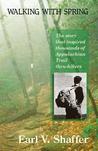
Review of 'Walking with Spring' memoir of the first AT thru-hike


Walking with SpringWalking with Spring by Earl V. Shaffer
My rating: 5 of 5 stars

I'm an old guy - Social Security retirement age. Yet Earl Shaffer accomplished what he called his 'Long Cruise' - the very first Appalachian Trail thru-hike - before I was born (but barely - I happened to be a fetus at the time). The year was 1948.

When you're the very first to do something there's a wall of uncertainty surrounding the endeavor that is hard to comprehend. The conventional wisdom among those involved with and knowledgeable about the Appalachian Trail at that time was that what Earl did was impossible. In fact many people refused to believe he had done it until he convinced them via personal interviews, during which he was grilled for trail details that only a hiker would know, and via testimonials of many 'witnesses' he had met along the way.

Earl and a friend had been making plans to hike the entire AT as far back as the 1930's, soon after the whole thing was finished. They lived not far from the trail in York, PA and they had gone on many backpacking trips along the trail near home. But then World War II came along. Earl found himself in combat in the South Pacific, and when he got back home he found the experiences hard to shake off. Worse, his friend did not return.

In the past few years there has been a burgeoning Veteran support group known as "Warrior Hike" that advocates that returning veterans 'Hike off the War' by doing an AT thru-hike. The participants find it very therapeutic--a good way to ease back into civilian life. Earl Shaffer was undoubtedly the first Warrior Hiker. It seems to me that he quietly dedicated his hike to his friend, and I believe this helped steel his resolve to finish, despite having to find his way through sections that had been neglected and unmaintained through the war, others that had been clear cut by loggers, and still others that had been rerouted without adequate marking. There was the 'Missing Link' between the Green Mountains of VT and New Hampshire's White Mountains where the trail barely existed at all.

Some of the early trail's shortcomings probably motivated Earl to want to help make the experience for other hikers better. After his hike, Earl went on to have a long distinguished career of service for the Trail. He knew most of the true legends, including Myron Avery and Benton MacKaye, to whom he dedicated his book. And it's a testimony to him that the publisher who opted to sign him was none other than the Apppalachian Trail Conference itself (now called the Appalachian Trail Conservancy).

Earl didn't write his book right away. It was first published privately in 1981, then picked up by ATC and made public in 1983. But during the 'Lone Expedition' as he also called it, he maintained a diary, and words from his 'Little Black Notebook' make frequent appearances in the final text.

Earl's writing style is down-to-earth, almost quaint in its old-fashioned simplicity, yet it rises to a standard of elegance and sophistication that many more recent trail memoirs are not able to match. Earl is a keen observer with a love for the history of the land, and he's a marvelous pastoral poet. The book is filled with well written verse and with descriptions of the country through which he was traveling. He describes elements of the human history of the land that I had not heard before despite my extensive reading about the trail. He covers the history of the inhabitants from pre-Columbian days, through early settlement, the civil war, to the then modern but now historic encounters with an amiable mountain man tilling his field with two mules and a walk-behind plow, a ride in a Model-A driven by a non-English-speaking Pennsylvania Dutch farmer, and Park Rangers who personally kept tabs on his progress and radioed the news north to their colleagues. His hike was a historic event, yet Earl's humble telling makes it feel personal and real. I especially delighted in his descriptions of places that I personally passed on my thru-hike in 2012--still there, still on the trail route after sixty four years.

As AT hiking memoirs go, this is one of the good ones--a must read.

View all my reviews

Wednesday, January 8, 2014

Feminism and the Paradox of Free Will

Sue Monk Kidd, advocate of 'Contemplative Spirituality' for 25 years.

We humans do selfish things (we 'sin'), and as a result we suffer and cause others to suffer. Fortunately we have free will to choose a better path and to fix things (find 'salvation').

Conservative Christians - those who believe that the Bible is infallible, inerrant, and all-sufficient - offer a very clear path to 'salvation'.  If you do what the Bible says (accept, surrender to, and profess the 'Message of the Cross' - a courageous act of absolution by proxy), then you will stop suffering and know the 'joy of God's love'.

There is a compelling clarity in this message, and I've seen it in action.  People who are horribly suffering, feeling hopeless and lost, hear this message and are transformed.  Their relief and release is immediate and real.  I've seen that 'joy of God's love' in their eyes, and it's contagious. Their excitement for this spiritual remedy attracts others, and so the message has proliferated lo these past 2000 years.  Hard to argue with the results.

So why would a true-believing 30-something southern Baptist Sunday School Teacher choose to reject Christianity and become a feminist and new-age spiritualist?

And why am I even bringing this up?

Well, that 30-something former southern Baptist was Sue Monk Kidd, and her life story resonates with me.  She's my age, we were born just weeks apart.  And she's gone through a significant spiritual arc, reaching a position near me from the polar opposite end of the spectrum.

Perhaps more to the point of why I bring this up now: She just released a new novel yesterday, 'The Invention of Wings'.  I ordered it today.

Sue's first novel, 'The Secret Life of Bees' was on the New York Times Bestseller list for 2 1/2 years and was made into a motion picture which just happens to be showing on BET tonight at 9PM eastern.  'The Invention of Wings' has been chosen by Oprah Winfrey as the latest novel for her Book Club 2.0, so it's bound to be a best seller too.

In the process of deciding to order this book I did a lot of reading and research about Sue, and I ran into some not-so-complimentary diatribes against her by a small vocal minority within the Conservative Christian community.

Why have these groups picked on her?  Before turning to novel writing, Sue was a regular contributor to the spiritual/inspirational publication 'Guideposts' and she wrote several book-length memoirs discussing her spiritual transformation.  Most notable of these was 'The Dance of the Dissident Daughter'.  I'll let the book review by Amazon Vine Voice 'Kelly (Fantasy Literature)' take it from here:

"Sue Monk Kidd spent approximately her first forty years in the Baptist church, where women are exhorted to submit to their husbands and where she heard the phrase "second in creation, first to sin" countless times. She was disgruntled with the church's stance on women, but never felt moved to rock the boat much, until one day she walked into her daughter's work and found two customers sexually harassing the girl. Something snapped inside her, and she began to question her religion's assumptions about gender and to seek a more feminist spirituality. Her journey took her to ancient mythology, the Gnostic gospels, and to dark places in her own life as her quest caused trouble in her marriage and her religious life. She tells us how she got through her troubles, and her story seems very human and touching. She would feel uneasy, drop the whole subject for months, but her longing always resurfaced. And in the end, she seems to have found peace, and some interesting insights. This book will be interesting to Christian women trying to figure out how to reconcile religion with self-respect. It was also interesting to me, as a pagan of several years and an agnostic before that--it helped me see value in Christianity that I had not seen before."
Sue herself wrote this:
"The minister was preaching. He was holding up a Bible. It was open, perched atop his raised hand as if a blackbird had landed there. He was saying that the Bible was the sole and ultimate authority of the Christian’s life. The sole and ultimate authority.
"I remember a feeling rising up from a place about two inches below my navel. It was a passionate, determined feeling, and it spread out from the core of me like a current so that my skin vibrated with it. If feelings could be translated into English, this feeling would have roughly been the word no!
"It was the purest inner knowing I had experienced, and it was shouting in me no, no, no! The ultimate authority of my life is not the Bible; it is not confined between the covers of a book. It is not something written by men and frozen in time. It is not from a source outside myself. My ultimate authority is the divine voice in my own soul."

Bottom line: Sue was suffering, but the Christian 'narrow gate' to salvation (Matthew 7: 13,14) seemed closed to her.

So what do you do when the simple formulaic road to salvation leads you only to more suffering?  Your first reaction is to rebel.  Thus Sue became a feminist.  Christianity in its liberal forms supports feminism, but Sue's pendulum was still swinging. Her free will took her down less traveled roads.  She found Goddess-consciousness.  She felt the Earth breathing.  The Universe had a beating heart.  And she sensed those immense forces welling within her.  The "pure inner knowing" that Sue talks about is the path called 'Contemplative Spirituality,' and it is a path that the vocal minority of Conservatives that I mentioned above call 'dangerous'.

Given the history that Christianity is obligated to own, I wonder which path is actually more dangerous when abused.  But that's a complex discussion for another time and place.

Free will is a tricky thing. The human body is nothing but a ridiculously fine-tuned colony of 37 trillion individual cells.  The colony has cobbled together a very subjective and selective executive narrative that we call consciousness.  Philosophers, Mathematicians, and Scientists have struggled to explain, even to define consciousness.  It's pretty plain to me that reductionism isn't ever going to get these analysts any closer to the truth.  I'll spare you my deeper musings here.  For now, I'll just say that 37 trillion voices evoking a minimum of 4 billion years of 'memory' are surely louder than one, and if there is any response from the universe to the narrative they have chosen, and I suspect that there is, then what our executive narrative chooses to do (our 'free will') *really* matters.  The seminal example is the Biblical God's experiment: granting Adam and Eve free will.  It was a bold sacrifice, but it breathed real life into the universe.  God only became relevant when he gave up his ability to predict what humans would do (this is the heart of the 'free will paradox').  The arc of the relationship between God and Man became the ultimate epic quest.  God groped for the best way to guide men toward his hoped-for result, and humans grew in knowledge and wisdom as they stumbled forward toward the same ends.  God's first attempts at persuasion were pretty crude and man's early behavior was pretty stenchy, including the abusive domination of the physically stronger male over the spiritually more centered female.  Result: a lot of people got hurt.  Think Sodom and Gomorrah or Noah's flood.  But God kept trying, for he 'so loved the world.' Finally, he gave men Jesus.  Need I go on?

The point: when you exercise free will more fully than many conservative Christians are prepared to let you do (as their God initially did), you can indeed stray and stumble and suffer, but you can also achieve exactly the same level of rewards that the Bible promises without all the baggage and dogma.

By abandoning the well-traveled road, Sue Monk Kidd chose uncertainty.  She spent years establishing her new course.  Salvation down this path is more subtle, takes more work, and so is not quite as overtly alluring.  The 'Joy of Universal Love' is definitely there, but it's quieter and more introspective.  And I'd argue that it's far more balanced and adaptable.

So why am I bringing this up?  Because I've followed similar paths.  For me salvation is more about the Joy of discovery of mankind's emergent purpose than my own, and of helping to chart the 'Noble Course' toward that purpose (I call it The Great Stream).  I've imagined where this path might ultimately lead in my fictional distant future epic fantasy 'Eden's Womb'.  These descendants of Homo sapiens have accomplished a 'Long Sojourn into Harmony and Balance,' bringing them into concert with the planet's ecosystems. For them salvation is not ultimately for the individual.  Such a selfish pursuit is more likely to result in false steps and more suffering.  The salvation that is most worth seeking is for humanity as a whole.

Tuesday, December 24, 2013

Ringworld, by Larry Niven, a book review


RingworldRingworld by Larry Niven
My rating: 4 of 5 stars

Larry Niven wrote Ringworld at a time (1970) when it was considered acceptable and even trendy for artists to disrespect their audience. Having lived through that era and having been battered by dissatisfying endings, by authors and movie directors playing mind games or treating me as if I was a toy for them to manipulate, I am ever-so-glad that fad disappeared quickly.

Ringworld isn't so bad as some.  It has a nicely satisfying ending and it presented a rich well-imagined world.  But the author's style suffered from a the 1970's-haute tendency to treat the reader as an outsider.  Perhaps it was just me.  Maybe hard-core fans of hard-core science fiction at the time had heard of all the myriad of imagined technologies that were mentioned--named--with the assumption that they needed no explanation, as if the reader was supposed to know as much about them as the characters living in that world.

The story is imaginative in the extreme. It throws together four characters - two humans and two aliens with cultural and physical differences designed to keep tension high - and sends them on a quest across the galaxy to a newly discovered artificial world built in the form of a ring that spins about its sun such that centrifugal force creates gravity and keeps its inhabitants pinned to the inner surface along with an atmosphere, oceans, soil, etc. Niven envisioned the ring as being 600 million miles in length (circumference) and a million miles wide. He barely bothers to explain how it might be built and maintained. Since it is always high noon at every point on the habitable inner surface of the ring he decides to suspend (using invisible wire of virtually infinite tensile strength) a series of sunlight-blocking 'shadow squares' between the sun and the ring in order to artificially create a day/night cycle. This is a peculiarly unnecessary complication (except for the fact that Niven's characters would eventually need some of that wire). People could shut their blinds. People live happily in Svalbard with no darkness for 4 months at a time.

The pace of the action is steady and gripping enough to have kept my interest. I enjoyed reading the book, but I did not enjoy the main character, 200 year old Louis Wu. The author uses him as an omniscient explainer of things that he could not possibly have figured out - including history and technology he had never seen, and even the behavior of the other characters. It was simply not believable even in this highly speculative sci-fi setting.

So lets talk about the setting - the technology. It bordered on pure fantasy and supernatural. Niven concocted a major catastrophe at the center of the galaxy which would destroy all life within a few tens of thousands of years. But he had a solution for it. And in fact he had a solution for virtually every physical limitation our real non-catastrophic universe presents us. He has immortality drugs, multiple kinds of stasis/suspended animation, psychic weapons, several technologies to travel and communicate faster than the speed of light, virtually indestructible materials suited to every imaginable need. And he didn't stop there. He assumes that genetic selection for god-like invulnerability (what he calls 'luck') could take place in six generations of breeding. He assumes microbes could evolve to feed on certain specific, plot-convenient, technology-critical materials but on few other easier-to-digest things -- e.g. he exposes his four heroes to all these evolved microbes and they don't get so much as a sniffle. It was all just a little much to take - I felt such a heavy burden of disbelief that in order to suspend it, I, too, needed some of his invisible 'shadow square wire'.

View all my reviews

Tuesday, December 10, 2013

Morality in an uncaring universe

Rihanna.  She has cooperated with established celebrities such as Eminem

What if there is an inherent morality embedded in our reality?  What if it can be shown to appear spontaneously from the primordial Chaos/Paradox and thus provide another sense in which random indifferent Paradox emulates ‘God’?

Well, modern computer studies of some notable paradoxical situations have revealed that this may indeed be the case.  The studies suggest that an individual being’s or a species’ success in any uncontrolled, iterated, competitive evolutionary process is correlated with certain key behaviors and attributes.  The better a living thing performs in following these 'rules,' the more successful it will be (no consciousness required):

  • Be nice. Cooperate with others by default: freely offer trust and respect; never be the first to act selfishly.
  • Be provocable when wronged, but never hateful: react to a selfish act (a sin) with an assertive defense, in like measure but not beyond.  “Eye for an eye.”  A wrong must be made right, not rewarded, not ignored. Respond to the sin, respect the sinner (as per the first rule above and the next one below)
  • Be forgiving: cooperate with a ‘sinner’ who returns to cooperation. Do this generously and immediately.  Do not hold a grudge.
  • Be humble (don't be envious): be fair with those around you. Do not try to out-compete them.  Do not be resentful if they out-compete you.
  • Be honest (don't be too clever/intelligent): Don't try to be tricky, sneaky, scheming, or subtle.  Keep your approach transparent.
As I said, these intrinsic rules for navigating existence apply to all living things equally, and no consciousness is required to obey them.  Noting this provides us with some surprising guidance regarding our relationship with our natural world:
  • Enslave no living thing, animal or vegetable: Gather, hunt, trap, and eat only those things that live wild and free. Yes, gardening is a sin, as is keeping a pet. That cute little kitty sitting in your windowsill next to that potted plant? Bad ideas; both of them sit there yearning to be on the other side of that glass. Agriculture is a pursuit that will ultimately fail us, especially the breeding and keeping of animals in industrial factory farms.
  • We are stewards of our world, not owners:  It is incumbent upon us to manipulate our surroundings as little as possible, and to leave it in as good or better condition than we found it.  In all you do, keep in mind the Seven Generations to follow.
This, to me, is good news - the best I could hope for.  I'll discuss the details in a moment.  But first let me offer the bad news: why Homo sapiens is going to go extinct:

Our current human culture (the species pejoratively called ‘bowlheads’ in my seven-book novel series 'Eden's Womb') fails miserably on nearly every one of the above counts.  We are too selfish and greedy.  We sometimes act hatefully.  Burdened by our self-importance and parochialism we fail to forgive in too many instances — the crucifixion of Jesus of Nazareth is perhaps the most important example of this in human history.  Too often we revert to covetousness and envy and seek ‘schadenfreude.’  And we are just too damn smart for our own good.  “It’s not nice to fool Mother Nature.”  In Eden's Womb, which is set more than half a million years in the future, Homo sapiens had long ago gone extinct.  Replacing them is a species I name Homo phronensis, after the Aristotelian concept of mature, practical wisdom called Phronesis (see his Nicomachean Ethics).

Now, how do those five rules basic emerge from pure indifferent Chaos?  Let's get to the scientific studies - which I'll try to present in simple, easy to understand terms.

Many of you have probably heard of the “Prisoner’s Dilemma.”  It's a paradox in decision analysis, but ultimately it is a social interaction exercise.  Two 'players' face one another and have two choices: cooperate with the other player, or betray her/him.

As originally posed, the Prisoner's Dilemma is this: You and a criminal associate have been busted for a crime that you committed together.

Fortunately for you, most of the evidence was shredded, so you are facing only a year in prison on circumstantial evidence. But the prosecutor wants to nail someone.  To do so, he needs your testimony.  So he offers you a deal: if you squeal on your associate – which will result in her/him getting a five year sentence – the prosecutor will see that you go free. Which sounds good, until you learn your associate is being offered the same deal – which would get you five years.

So what do you do? The best that you and your associate can do together is to not squeal: that is, to cooperate (with each other, not the prosecutor!) in a mutual bond of silence, and do your year. But wait: if your associate cooperates (that sucker!), can you do better by squealing ("defecting") and get sprung from jail? It's tempting, but then he's also tempted. And if you both squeal, oh, no, it's five years for both of you. So perhaps you should cooperate – but wait, that's being a sucker yourself, as your associate will undoubtedly squeal, and you'll rot in prison for five years. So what is the best strategy to minimize your incarceration?

In the most generalized version of this game it is the story of real life.  Each 'play' represents a basic ‘unit’ of social interaction that confronts us innumerable times every day.  And with each unit we must choose from two simple alternatives: Act cooperatively/altruistically, or act selfishly.  Broken down to its most basic elements, every action we take becomes a series of binary choices, 'Black vs. White'.

And in countless contests conducted and monitored by experts this fundamental game of social interaction is invariably won by following the five rules listed above - a moral code that not so much emerges from nothing but comes pre-packaged the way mathematics itself does.


So ... the dry, indifferent realm of mathematics points the way to a moral code.  How does the Prisoner's Dilemma and the resulting five rules apply to us in our every day life?  In some surprising ways:

Whether we know it or not, we are constantly playing this game with every other person in the world, including people we've not only never met, but do not even know exist.

Consider this: Very few of us would go out of our way to ‘bad-mouth’ or ‘trash’ a complete stranger.  But most of us would treasure the chance to connect with people that we've never met in order to establish some mutually beneficial relationship.  And what better way to make an impression on them than to do something altruistic.

We all want our cup to 'runneth over' with adoring fans.  So there is an obvious bias toward cooperation.  But the cup can also be viewed as half empty: If we sit at home, in our own little cocoon and don't reach out to our potential fans, then this passive option - inaction - can be considered a negative choice: a selfish act.

Who hasn’t heard that venerable old saying: “If you’re not with us, you’re against us.”  Even Jesus of Nazareth said that (Matthew 12:30).

Every one of the seven billion strangers that you've neglected to connect with is a failed social bond and a potential enemy left unconverted.  That's a harsh judgment, I know. But it makes a point:

The highest ‘score’ in the social interaction game goes to those who try the hardest.  Think of these examples:  Mother Teresa, the Buddha, Paul of Tarsus, and … yes … young 25-year-old Rihanna: the single most 'liked' individual on Facebook.

Your choice to engage the people around you positively is the winning strategy.  Your choice to remain aloof and not interact with them is the choice that fails.  When I look at things this way, it is utterly transformative!

*******

Now to delve a little more deeply I'm going to get a bit more technical, let's take a look at the math of the Prisoner's Dilemma Game (don't be scared - this is not very complicated):

Let's assign symbols to the various outcomes of the game:

In every decision unit of the game, if you and your partner/opponent cooperate it produces a modest reward, "R", for both players.  If one of you chooses the selfish option but the other participant ‘turns the other cheek’, the immediate result is a large taking “T” for the selfish one and a large suffering “S” for the victim.  If both of you choose your own selfish interests, then both pay a certain Penalty, "P", in the resulting conflict.

In formal mathematical terms, for the individual participant in the Prisoner's Dilemma game, these four outcomes are arranged from largest reward to largest cost thusly:  T > R > P > S, where the symbol > means "greater than".  We'll call this relationship "Inequality (1)".  These relative sizes define the phenomenon, and so are fundamental to it.  Other arrangements don't work.  Some simple thought exercises can confirm this.  In the real-world context the relative 'size' of the four variables, as specified above, makes intuitive sense:

T: Mugging on the street/Warriors pillaging the innocent: "To the victor go the spoils.”  Big payoff for the winner.

R: Peace: "We get no spoils, neither do either of us suffer."  Biggest combined payoff, but never the maximum score.

P: War: "The battle between us will be bloody, so even the winner will suffer losses.”  Rarely as rewarding as Peace and co-operation.

S: Mugging on the street/Warriors pillaging the innocent: "The victim suffers exceedingly.”  The loser endures not just from the physical defeat, but also psychologically.

So Inequality (1) mirrors real life: The Temptation to act selfishly T offers a pay-off greater than the Reward for mutual cooperation, R.  But the Reward for cooperation is better than the Penalty P for always acting selfishly.  And the worst cost, S, is reserved for the "Sucker" who chooses to cooperate, faces a selfish ‘opponent’, and is robbed blind.

Now ... The Prisoner's Dilemma game is most relevant to our reality when it is played over and over among a large and diverse group of players.  This is called the "iterative" version.

In order to be a valid model of reality, the iterative version of the Prisoners Dilemma game also requires that 2R > T + S.  Let's call this Inequality (2).  It means that the combined reward to two players who cooperate must exceed the sum of the benefits achieved by one Sucker and one selfish player:

That might seem like stacking the deck - a rule that fixes the outcome.  But in the natural, very real world of human interactions this stipulation, in the long term, is naturally met without anybody forcing it to be so:

Think of it this way: A mugger on the street will sometimes come away with very little whereas her/his victim will always suffer in some way.  Both players have higher stress levels during and after the encounter than they would have if they agreed to cooperate.  The resulting sum is therefore almost always less than the alternative: ‘Both of us respect each other, keep what we have, and cooperate to get more.”


So in reality, since this inequality (2) does apply.  Nature itself stacks the deck.  Two heads are better than one.  You attract more bees with honey than with vinegar.


Do Nice guys finish last? Only if they ignore another old saying: fool me once shame on you, fool me twice shame on me.

Be nice but not gullible, be humble, forgiving, and honest and you'll end up on top of the evolutionary mountain.

And if you find the 'pearly gates' up there ... if there's a caring God there waiting for you ... well, now you know why.

Tuesday, December 3, 2013

Game of Thrones - a medieval soap opera


A Game of Thrones (A Song of Ice and Fire, #1)A Game of Thrones by George R.R. Martin
My rating: 4 of 5 stars

George R.R. Martin has a writing style that I crave: crisp, vivid, full of rich detail, evocative through all five senses. He's a master at his craft. When I write, I try to achieve this type of style, so in 'Game of Thrones' I have a wonderful 'textbook' full of top-notch examples. Yet as a model for story telling it's not to my taste. More on that later. First, more high praise:

If there was ever an author who deserves the accolades that he has received, Martin is it. He is literally a born writer and a natural story peddler. When he was a kid he gave dramatic readings and sold his monster stories for pennies to neighborhood children. He's been working at his craft ever since. Game of Thrones is no 'overnight success story.'

Yet the story of its beginning is a mercenary tale: Martin knew he wanted to write an epic fantasy, inspired by Tolkien in particular. Yet he had no concept of what he wanted to write. Finally the idea of a set of siblings adopting direwolf pups came to mind, and he was off and running. Still, he sold the story to a publisher with only a quarter of it written.

The result of that premature acceptance was a book without an ending. Game of Thrones is in no way a stand-alone tale. After 800 pages, Martin leaves all of the story lines hanging, largely unresolved ...

... much like a soap opera. Yes, this was my first impression and it persisted to the end. Game of Thrones is not so much a fantasy as it is an elaborate soap opera in a classic medieval setting. And soap operas aren't my cup-o-tea.

When I read a fantasy novel I'm looking for innovative and imaginative settings. What Martin gives me are text-book medieval settings. I want plots involving unusual creatures and metaphysical elements that have not been previously explored – things to send my imagination soaring in new directions. The characters in the story ought to find a significant part of their conflict coming through entanglement with these imaginative new elements - moreso than through getting in each others' faces. Martin seems to prefer the character interplay. He barely dabbles in anything metaphysical and only trots out a few zombies and baby dragons at the very fringes of the story. The rest of it is just historical-style fiction meticulously well researched and well written, but not what I’m after.

The story is written through the limited point of view of eight of the principal characters, all but two of which are members of the immediate family of Ned Stark. Ned is lord of Winterfell - a northern stronghold in an island nation modeled after Great Britain (geographically as well as ethnically). To his north is an ancient wall that is the frontier of civilization, modeled after China's Great Wall. To his south is Ned's good friend the King and an array of ambitious noble families with conflicting interests, full of grudges and entanglements with one another. The plot begins to thicken when the King's Hand (his chief executive) is murdered and Ned is called south to take his place.

And the plot just continues to thicken. As events unfold we are shown great castles of many descriptions, all beautifully realized, we experience jousts and sword-play, betrayals and executions, squalid brothels and grand state dinners, and ultimately war. And everywhere there is blood. Martin seems to find an interesting or unexpected way to make someone bleed profusely in every chapter. Did I mention that he was a Hollywood screen writer before he wrote Game of Thrones?

Okay, all in all a rousing good time if you like that sort of thing. I'm sure I'll be reading on through the rest of the 'Song of Ice and Fire' saga. I'm told there will be seven books in all, possibly even eight, two (or three) not yet finished as of the end of 2013. Martin is sixty-five, barely a month older than I am, and he's been writing one new book in the series about every five years. Let's hope his health and his enthusiasm hold.


View all my reviews