The vast majority of the tree species have bud tips that are popping open and turning green. There's a faint color cast painting the fringes of the forest trees as seen from overlooks and viewpoints all over the valley.
At the cloister proper, the majority of the young Tulip Trees in the plantation in the 'Yarrrrrrrd' have cracked open their buds and are showing green, and the most precocious of them began unfurling its first tiny leaves today.
So ... Yep. The weight of the evidence no longer leaves room for any doubt.
Welcome to Spring at the Cloister at Three Creeks!
Tulip Poplar, or Yellow Poplar (Liriodendron tulipifera) is the central focus of today's search for the answer to our question - On what day does spring officially arrive at the Cloister at Three Creeks?
This species of tree has been my favorite from my days roaming the woods of far SE Pennsylvania as a child. In 1964 I did a comprehensive documentation of the bud-opening of ten different tree species, drawing 'plates' in the tradition of the old botanists. One of these plates documented the Tulip tree:
Note the date of first bud opening in 1964 - April 10th. The area of these observations has virtually the identical climate to that of the Cloister at Three Creeks (this is confirmed by comparing current observations of the progress of spring in that area to my observations here at the Cloister). This year we are talking a shift of two weeks or more, to earlier onset of bud opening. This may be a sign of the effects of global warming; but whatever the cause, the same trend is observed in the observations of the peak bloom of the famous Japanese Cherry Trees on the mall in Washington DC. Over the past century, the average peak bloom date has moved six days earlier.
So ... what do the trees tell me, in answer to the question? Is it spring? Are we there yet?
Also featured in the video is a look up the mountain at the 'overlook' where I recorded the previous video on March 21st.
View from the overlook, March 21st.
View of the overlook, as seen from the Cloister, March 22nd.
The backdrop is the trashed zone of cleared forest in the 'Yarrrrrrrrd', where the previous owner had cut down more than a dozen mature, majestic oaks, and piled their skeletons in a heap, left them there to rot. The 'Yarrrrrrrd' is now regenerating and has become what I refer to as my 'Tulip Poplar Plantation'. Yet within it there are still surprises. While doing the video today, I discovered a man-made feature, which, in eighteen months at the Cloister, I had never before noticed.
I've taken dozens of videos all around the remote undeveloped valley in which the Cloister at Three Creeks sits, but this video focuses on its most outstanding feature--a world class waterfall, or series of cascades, dropping roughly 400 feet off the east side of Virginia's rugged Blue Ridge Mountains.
The terrain is so steep and rocky that the best parts of this waterfall are virtually never visited.
Yesterday, March 21st, I climbed up to a rock outcrop with a clear view of the entire set of cascades--a view you can't get at any other place, nor during most of the year. This is by far the best time for this view, when the sun is bright and high, but before the trees begin to leaf out.
The video starts with the view from this rock outcrop, and then takes you on a bottom-to-top tour of the cascades. The tour videos were taken either on November 17th and 18th of last year during the time of leaves changing color, or, in two cases, on July 19th when the succulent wineberries were at their sweet, juicy peak of production. Why wineberries? What do they have to do with the waterfall? Check it out.
On Sunday, 20 March, at 11:33AM Eastern Daylight Time, the sun passes directly overhead at the equator, saying farewell to the Southern Hemisphere and coming northward to warm our half of the world for the next six months.
It's called the 'Vernal Equinox' and it marks the official (technical) start of the spring season.
Here at the Cloister at Three Creeks, Mother Nature got the memo, and spring is busting out all over.
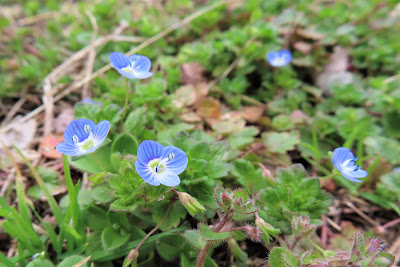
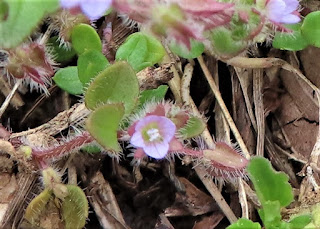
This video is a celebration of some of the new blooms found today, March 19th, less than 24 hours before spring arrives. Most of them turn out to be invasives, though they seem to be as natural as ... well ... dandelions in the grass. Yes, both Dandelions and Violets were introduced from Europe. Two other first blooms found today are also outsiders, coming from Eurasia. They are both Veronicas, and both blue or bluish -- the Blue Veronica and the much less showy common Veronica.
Also featured today are some of the evergreen plants that have abided all winter.
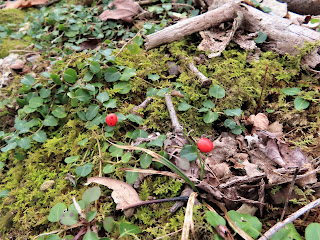
Partridge Berry (Mitchella repens)
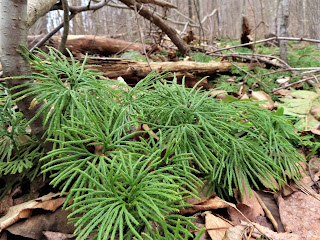
Ground cedar (Diphasiastrum digitatum). This is a clubmoss, one of the truly ancient plant forms, which has very simple structure and reproduces via spores.
Special attention is given to the views of the Cloister's three creeks - views that will be going away as the leaves fill the forest. We visit Gravelly Creek as it falls over the Escarpment into Stoney Creek's flood plain, we visit the 'Gathering of Many Waters' where Flat Rock Creek joins Stoney Creek, which is divided here into three channels, so that it appears that four streams gather into one.
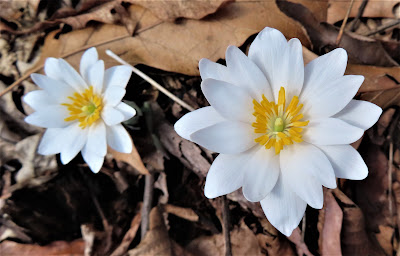
Finally, we visit the audio-experience of the 'Loudwater' cascade on Stoney Creek; and we end this video with a look at a rare semi-double form of the showiest spring flower in the temperate deciduous forests of eastern North America this time of year - the Bloodroot: Sanguinaria canadensis.
We await one last confirmation of the arrival of spring at the Cloister--the swelling and opening of the Tulip Poplar buds in the young plantation. For that you will have to stay tuned.
There were so many new spring wildflowers blooming today, March 17th, St. Patrick's Day, at the Cloister at Three Creeks that it is getting hard to keep up with them all. This may be the last post that even tries to be comprehensive in its reporting of every new thing that makes its appearance.
Even the tree buds are beginning to swell and open -- not yet the official Tulip Poplar buds in the young trees in the plantation in the Cloister's infamous 'Yarrrrrrrrd'. But those will very likely be bursting open in just a few days.
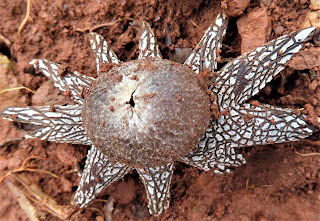
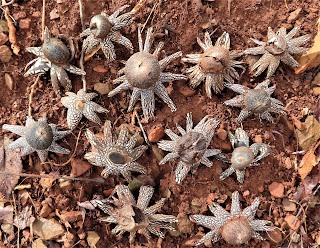
Other than the new flowers and tree buds popping out, today, on damp drizzly start to my hike, I ran into a thing that one can miss entirely unless hiking in these damp conditions. The fungus called Astraeus hygrometricus sits locked as an inconspicuous brown ball in the dirt until damp weather comes. Then it unfurls its flower-petal-like "legs" and literally lifts its spore producing puff-ball-like organ up into the air to attract passing pollinators. The unit is entirely disconnected from the ground, too, so that with a gust of wind it can blow around like a tumbleweed and migrate to more favorable sites. Here is what nature can 'program' into a simple fungus, given literally millions of years to tweak the program. Such a wondrous, miraculous, majestic display of resourcefulness and complex engineering! Wow.
False Earthstar, Astraeus hygrometricus
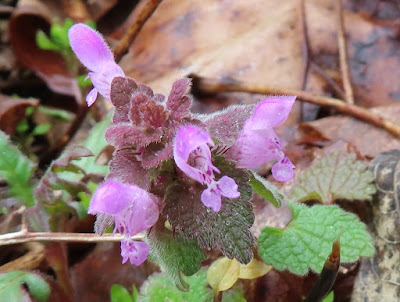
Purple Dead Nettle (Lamium purpureum)
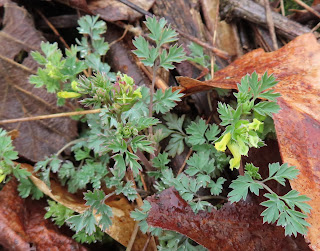
Yellow Corydalis, or Corydalis lutea. This is an introduced species native to the foothills of the southern and southwestern Alps of France and Italy.
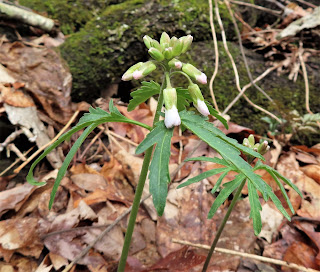
Cutleaved Toothwort, Cardamine concatenata
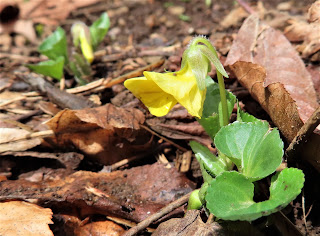
Roundleaf Yellow Violet (Viola rotundifolia)
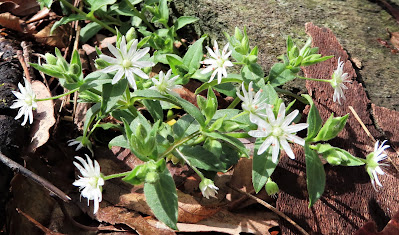
Star Chickweed, or greater chickweed. A lone bloom of this was featured in a video about a week ago but this neatly arranged cluster seemed worthy of sharing.
I continue patrolling the environs around the Cloister at Three Creeks in search of signs of spring and commenting on anything else I find to be of interest.
Well, I found two new wildflower blooms, though one is not a native. But the most unusual encounter today is the distinctive 'graffiti' left prominently in the middle of the trail on a carefully chosen rocky pedestal, or display platform. This is no accident. Nature's programming, which has taken millions of years to develop and refine, assures that the animal kingdom wastes no opportunity and does very little that is purely meaningless and random.
At the end of today's 4.5-mile hike I returned to the Cloister and just sat at my new favorite spot and soaked up the sounds of the rushing rapids. What a special place I am blessed to be a part of.
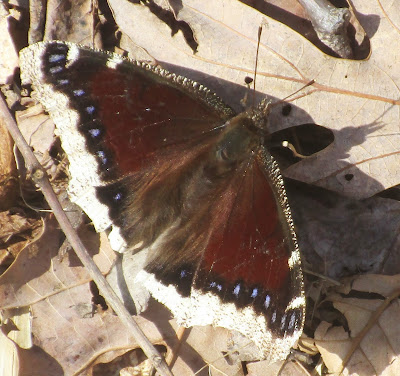
Here I follow up on some early spring flowers and on the 'Mourning Cloak' butterfly that I met and captured digitally as the first signs of spring over the past week.
SPOILER ALERT: The Mourning Cloak butterfly, I learned, over-winters as an adult, and is able to hide and sort-of hibernate in cracks and crevices of trees even in the coldest weather, then does a sort of 'shivering' act to warm itself up. So, these guys/gals are ready to hit the air as soon as there's any half decent weather, and they could easily survive that brutal spring storm. Their food is primarily tree sap, so they probably do not serve as pollinators.
Since I photographed these early pioneers of the new season, a fierce winter storm roared through the Blue Ridge Mountains with 5 to 7 inches of snow, 50 mph winds, and the temperature plunging into the single digits.
I was wondering how these denizens of the deep woods coped with such an extreme weather change, so today I revisited some of them.
There are also a few new features, sort of a potpourri of observations and experiences on this four-mile hike, which took me 1200 feet up a mountain side and back down again in a big loop.
Did these adventuresome early arrivals survive? Or was their premature emergence all a grand folly that ended in their quick demise?